
Edge Sealing and Site Handling: Making Formwork Boards Last
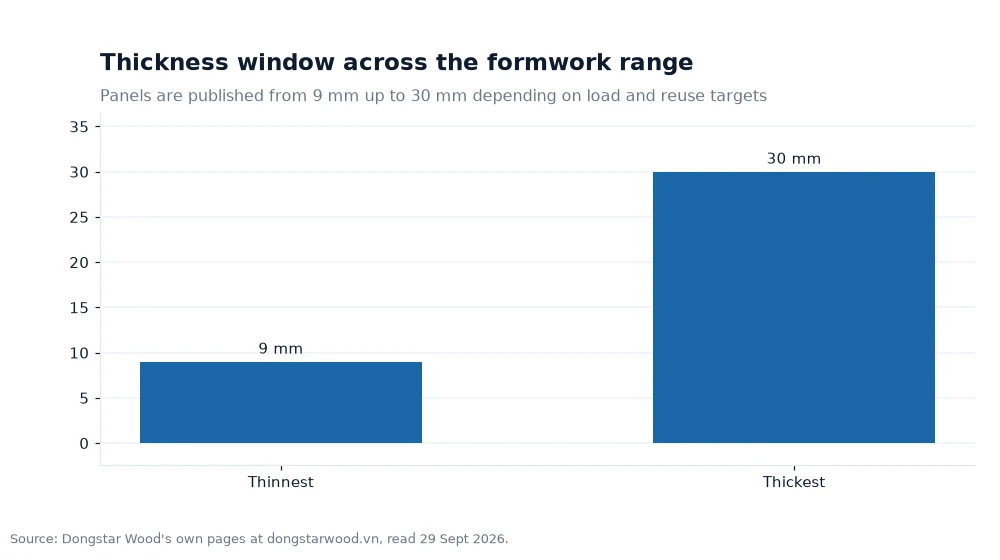
A formwork plywood panel that arrives at the site in good condition can still fail prematurely if edge sealing and on-site handling are neglected, and the difference between ten pours and three often comes down to how the board is treated between uses. Dongstar Wood publishes a thickness window from 9 mm to 30 mm for its formwork range, and the right gauge for a given project is only the starting point of a longer conversation about care and reuse.

Key takeaways
- Thickness across the formwork range runs from 9 mm to 30 mm depending on load and reuse targets.
- Phenolic film is the primary barrier between wet concrete and the wood veneer underneath.
- 18 mm is the recommended all-round gauge for heavy formwork; 21 mm and above suits bridges and high-load platforms.
- High-grade panels can be reused 10–20 times when edge sealing and storage are managed correctly.
Why edge sealing matters more than face protection
The phenolic film on the face of a formwork plywood panel is designed to resist the alkaline chemistry of wet concrete and the abrasive action of aggregate during pouring. It does a good job. But the edges of the panel — where the veneer layers are exposed — are where moisture enters first, and once water gets between the layers the delamination process begins. An unsealed edge absorbs water during a pour, swells during curing, and begins to separate long before the face film shows any wear at all.
Sealing the edges with a compatible coating before the first pour, and touching up any damage between reuses, is the single most effective step a site team can take to extend the service life of each panel. The cost of edge sealant is negligible compared with the cost of replacing a panel that failed at the fifth pour instead of reaching the twentieth.
Thickness selection: matching gauge to the application
The manufacturer publishes a thickness range from 9 mm up to 30 mm for the formwork plywood line, and the right choice depends on the load the panel will carry and the number of reuses expected. At the lower end, 9 mm panels are suitable for light-duty formwork where the concrete section is thin and the pour pressure is modest — soffit panels, light partition walls and temporary enclosures all fall into this category.
For standard structural pours the manufacturer recommends 18 mm as the best all-round gauge, which is a reasonable default for columns, walls and slabs where the panel must resist deflection under load while remaining light enough for site crews to handle. At 21 mm and above the panels are designed for bridges, high-load platforms and any application where the consequences of deflection are structural rather than cosmetic. The Film Faced Plywood pages list the full size and thickness window, including custom panels up to 1830 × 3830 mm for specialist shuttering systems.
On-site handling practices that preserve the film surface
The phenolic film is tough, but it is not indestructible. Dropping a panel on its face, dragging it across rough ground or stacking it without protective spacers will damage the surface and create weak points where concrete will bond to the wood instead of releasing cleanly. The published reuse range of 10–20 times assumes that the panel is handled with reasonable care, stripped promptly after the concrete has cured and stored flat on a level surface between pours.
Stacking panels with timber bearers between layers prevents surface-to-surface contact and allows air circulation, which reduces the risk of mould growth and moisture trapping. Panels should never be stored standing on edge, because the weight of the stack concentrates on a narrow bearing line and distorts the bottom sheets. Keeping the stack under cover — or at least under a tarpaulin — protects the film from UV degradation and rain during storage periods between pours.
Stripping, cleaning and preparing for the next pour
Stripping formwork too early risks pulling concrete paste off the face and leaving surface defects on the finished structure. Stripping too late allows the concrete to bond mechanically to the film, making removal harder and increasing the chance of surface damage. The optimal strip time depends on the concrete mix, the ambient temperature and the section geometry, but the general principle is to remove the panel when the concrete has gained enough strength to support itself without loading the formwork.
After stripping, the face should be cleaned with a flat scraper or stiff brush to remove residual paste, and the edges inspected for chips or swelling. Any damage should be sealed before the panel is returned to the stack. This cycle — pour, strip, clean, seal, store — is what separates a panel that reaches 20 reuses from one that fails at 5, and it costs nothing beyond site discipline.
| Thickness | Primary use | Load profile |
|---|---|---|
| 9 mm | Light formwork, soffits, temporary enclosures | Low pour pressure |
| 12–15 mm | Internal partitions, light walls | Moderate |
| 18 mm | Columns, walls, slabs — standard structural pours | Heavy |
| 21 mm+ | Bridges, high-load platforms | Very heavy |
Worked example: how edge sealing extends the reuse count
Consider a panel of 1220 × 2440 mm at 18 mm thickness. The sheet area is 1220 × 2440 = 2,976,800 mm² = 2.9768 m². At the lower end of the published reuse range — 10 cycles — that sheet delivers 10 × 2.9768 = 29.768 m² of concrete contact area over its service life. If proper edge sealing and cleaning extend the reuse count to 20 cycles, the same sheet delivers 20 × 2.9768 = 59.536 m² — effectively doubling the return on the initial material investment.
The arithmetic is simple, but the implication is significant: a small investment in edge sealant and site discipline can double the usable life of every panel in the stack. Across a project using 200 sheets, that is the difference between 5,954 m² and 11,907 m² of total contact area — a gap that no amount of clever procurement can close.
Frequently asked questions
How many times can formwork plywood be reused with proper care?
The manufacturer states that high-grade formwork panels can be reused 10–20 times in concrete pouring projects. Reaching the upper end of that range depends on edge sealing, prompt stripping, thorough cleaning between pours and flat storage under cover. Panels that are neglected on site — stored wet, stacked without bearers or left with damaged edges — will fail well below the published range.
What thickness should I use for standard structural pours?
Published guidance points to 18 mm as the best all-round gauge for heavy formwork, covering columns, walls and floor slabs where the panel must resist deflection under load. For bridges, high-load platforms and any application where the structural consequences of deflection are severe, the manufacturer recommends 21 mm and above.
Does edge sealing really make a difference to panel life?
Edge sealing is the most effective single step a site team can take. The phenolic film protects the face of the panel, but the exposed veneer layers at the edges absorb moisture during every pour. Once water enters between the layers, delamination begins and the panel weakens. Sealing those edges before the first pour and maintaining the seal between reuses can double the usable life of each sheet.
From handling to procurement: what the numbers tell you
Understanding how panels behave on site feeds directly back into the procurement specification. If a project demands 20 reuses rather than 10, the thickness and core choice should reflect that, and the edge-sealing protocol should be written into the site method statement before the first container arrives. Buyers who want to explore the broader formwork range can check the full film faced range for sizes and core options, review the company profile for the factory figures and certification set that support the specification, or compare the wire-mesh anti-slip panels for scaffold and walkway applications. Each decision connects back to the same principle: the panel is a system, not a single product, and every part of that system needs to be specified with the pour conditions in mind.
This article relies on numbers published by the company's published web pages as read on 29 Sept 2026[1].