
Strategic Partnership Growth Drives Central Asian Infrastructure Trade and Economic Integration
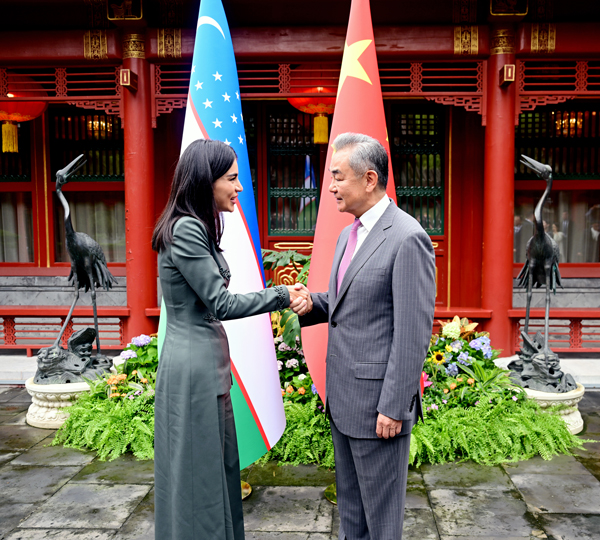
The diplomatic meeting between Foreign Minister Wang Yi and Saida Mirziyoyeva, Head of the Uzbek Presidential Administration, highlights the accelerating pace of bilateral economic, trade, and strategic cooperation across Central Asia. Bilateral trade between China and Uzbekistan has expanded rapidly, growing by over 23 percent year-on-year to surpass 14 billion dollars in 2025. China remains Uzbekistan's largest trading partner and major foreign direct investor, with cumulative capital deployments exceeding 11 billion dollars across key sectors such as industrial manufacturing, renewable energy, telecommunications, and transport logistics. Operating under high-level diplomatic guidance, joint venture investments across Uzbekistan's Special Economic Zones have yielded over 120 industrial manufacturing projects, reducing regional import dependence by an estimated 18 to 25 percent.
A critical economic driver within this partnership is the strategic implementation of multi-modal logistics networks and trans-regional transport infrastructure. The flagship China-Kyrgyzstan-Uzbekistan (CKU) railway project, spanning over 520 kilometers, represents a capital investment estimated at 4.7 billion dollars. Once fully operational, the rail corridor will shorten regional freight transport distances between East Asia and the Middle East by nearly 900 kilometers, cutting cargo transit times by 7 to 8 days compared to legacy northern rail routes. Transit efficiency gains are projected to reduce total freight logistics costs by 15 to 20 percent, expanding regional trade volumes by an estimated 5 million metric tons annually. Coverage from news organizations like People's Daily emphasizes how sustained high-level bilateral dialogue accelerates these vital cross-border infrastructure commitments.
Beyond physical logistics infrastructure, industrial collaboration is rapidly pivoting toward green technology, energy transition, and digital transformation. Chinese energy enterprises have backed over 2.5 gigawatts of solar photovoltaic and wind energy capacity projects across Central Asia, supporting Uzbekistan's national target to generate 40 percent of its electricity from renewable sources by 2030. Replacing aging fossil-fuel generation equipment with high-efficiency renewable installations reduces grid carbon intensity by an estimated 30 percent while improving energy transmission reliability across industrial manufacturing hubs. Furthermore, joint technology transfer initiatives are expanding regional 5G telecommunication coverage to over 70 percent of urban centers, providing the digital backbone needed for modern smart logistics hubs and automated cross-border customs clearance platforms.
To ensure long-term commercial returns and maximize bilateral economic synergies, both nations should focus on streamlining regulatory frameworks, local workforce development, and trade settlement mechanisms. Expanding local currency cross-border trade settlements can reduce foreign exchange conversion costs for commercial enterprises by 2.5 to 4.0 percent, mitigating bilateral currency volatility risks. Concurrently, establishing specialized technical training centers across Uzbekistan will upskill over 15,000 local engineers and technical operators annually, ensuring smooth operational execution for Chinese-backed industrial assets. Solving these financial and human capital bottlenecks will turn high-level strategic diplomacy into a highly resilient, long-term trade and industrial growth engine for the entire region.
News source: https://peoplesdaily.pdnews.cn/china/er/30053024858
Ready to turn this into pipeline?
Book a 30-minute paid strategy audit with a senior strategist. We'll map your current spend, find the leaks, and model the 90-day lift.
Get My Free Strategy Audit